Wednesday, December 9, 2015


GEOFF SHACKELFORD, has it right again!

USGA, ASGCA Partnering For Pro-Bono Design Services

I know what you're thinking, the USGA has been changing courses free of charge for decades. 
But this is actually a program geared toward courses no hosting championships and hosting the everyday golfer. Certainly something like this is a long overdue use of the Green Sectionand of architects, though I do fear for courses receiving recommendations designed to generate pricey re-construction of greens to USGA specs.

What also is missing: the USGA maybe commiting some of its $400 million in reserve to the occassional restoration of a worthy muni. Oh well, a great start...
FOR IMMEDIATE RELEASE

USGA, AMERICAN SOCIETY OF GOLF COURSE ARCHITECTS ANNOUNCE PARTNERSHIP
TO SUPPORT PUBLICLY ACCESSIBLE GOLF COURSES

FAR HILLS, N.J. (Dec. 8, 2015) – The United States Golf Association (USGA) and the American Society of Golf Course Architects (ASGCA) have launched a collaborative program to help publicly accessible golf facilities improve the design and maintenance of their courses and deliver a better experience for their customers.

Combining the expertise of ASGCA member architects and USGA agronomists, scientists and researchers, the program will provide pro bono consulting services to facilities that need assistance to achieve their goal of making  their layouts more enjoyable and reducing their maintenance costs.

“Course design and maintenance form the foundation of a golf facility’s operations,” said Mike Davis, USGA executive director. “With the knowledge that the ASGCA and USGA can offer, more publicly accessible facilities will be able to strengthen this base, while promoting resource efficiency, a better golf experience and a stronger connection to the local community.”

Starting today, facilities can submit an application for the service, which will include an on-site evaluation, professional analysis and a report outlining recommendations for improvement. Recommendations can cover course design, agronomy, environmental stewardship and golf course operations, with the goal of lowering costs while also improving the golfer experience.

“The ASGCA, along with the ASGCA Foundation led by John LaFoy, is pleased to partner with the USGA on this initiative,” said Steve Smyers, president of the ASGCA. “Golf facilities have long benefited from the efforts of ASGCA members and USGA agronomists. Collaboration between our experts will have a positive impact on the facilities we support. ASGCA members are excited and proud to bring their expertise to this program.”

Interested facilities must submit an application by one of three deadlines over the coming year: March 15, Aug. 15 or Dec. 15. The application can be found here.

Canal Shores Golf Course, a community-owned and operated facility in Evanston, Ill., is the first course to receive a pro bono evaluation through the program.

“This has been an incredible opportunity,” said Jason Way, of the Canal Shores planning committee. “We have some great ideas about how to improve the course, but the assistance from the USGA and the ASGCA allows us to get past the initial planning process, so we can move forward with our vision for making Canal Shores a multi-use community green space that the maximum number of people can enjoy.”

Selected facilities must express a willingness to carry out the recommendations from the USGA and ASGCA. Facilities will be expected to track and report the effectiveness of their improvements based on specific metrics.

A video that shares more detailed information on the program and Canal Shores can be found at usga.org via the following link.

The partnership complements the USGA’s course consulting services, which deliver implementable solutions to support a healthier future for golf facilities. In October, the USGA also announced a five-year master research partnership with the University of Minnesota to study and develop solutions to golf’s present and future challenges, including environmental sustainability.
The video features Hunki Yun explaining the program from the USGA's new Far Hills TV set. Love the echo chamber vibe!

Here is the application page.

My Comments:
Geoff,

I don't know whether we should laugh or cry. It's kind of like hearing those words, "We're the government and we're here to help." "We're the USGA and the ASGCA and we're here to help." A bit of skepticism is warranted.

Hopefully, these "agronomists" will steer courses away from building USGA greens. In my opinion, the USGA green is a costly mistake and is the highest source of pollution per square foot of turf in the world.

My thoughts on USGA greens:

http://aggca.blogspot.com/2010/02/usga-greens-and-emperors-new-clothes.html
12.8.2015 | Unregistered CommenterArmen Suny

Thursday, November 19, 2015


Dave Wilber: Turfgrass Zealot

The Turfgrass Zealot Project, Ep. #10 Talking Job Searches and Job Interviews with Armen Suny


TO LISTEN CLICK HERE

Join Dave Wilber and Armen Suny as they take a deep dive into the world of job searches and job interviews.
Episoide 10 of The Turfgrass Zealot Project is not short on passion. Dave Wilber and Armen Suny really want you to succeed in your career goals. Handling the job search and the job interview is key to making that happen. Learn some incredible techniques. And be reminded of some very simple things that could put you in the position you want to be in. There's a lot of mistakes being made out there. Don't let them be yours.

Armen Suny's work with Kopplin and Kuebler, an executive search firm, is fascinating and insightful. And you get to hear first hand what is really happening in the trenches from someone who is focused on the world of golf.
Dave Wilber lays on some thoughts about doing it right and paying attention to detail in his opening remarks.

The Turfgrass Zealot Project is brought to you by Klingstone. Proven Bunker Performance for Fifteen Years!

Thursday, July 16, 2015

Richard Zokol Interview on St. Andrews and the Open


Canadian Golf Hall of Fame member Dick Zokol shares his extensive experience on the Old Course, including one story about Shetland ponies in the Road Bunker that we won’t go into here, Jordan Spieth, Dustin Johnson, Rickie Fowler, Tiger Woods and all things British Open.
To listen to that conversation with Hutch, click below.

Friday, June 26, 2015

Suny on Turfnet Radio with Dave Wilber

Yesterday, I was on Turfnet Radio with Dave Wilber, talking design, renovation, fescue greens, US OPEN, executive search, it was a wild ride!


Wednesday, June 17, 2015

Fescue Follies...Not the Best Choice for Greens

The US OPEN is being played at Chambers Bay on a neo-links course which could be called moderately authentic, down to greens that were seeded to fine fescues. The romanticism of links golf with fescue greens will be short lived this week and we'll be hearing more about it as the Championship unfolds.

Why? Josh Lewis, the Superintendent, also known as the Turf Yoda has done an outstanding job preparing the golf course for this Championship. But he has been dealt a losing hand with the selection of fine fescue greens. Fine fescue greens have had little success in North America, when placed in geographic areas that have temperatures that are much higher than the successful fescue greens in European venues normally withstand. St. Andrews highest daily average temperature for the year is 66 degrees, Tacoma averages four months that the average high temperature exceeds 66 degrees. Fine fescue just isn't in its element, no matter how much we wish it would work on greens.

Poa annua, the grass that is the predominant grass on greens from coastal Northern California up through coastal Canada has invaded the greens at Chambers Bay. Not a surprise to anyone that understands turf management. So, now there are two distinctive grass types on the greens with very different growth habits. This will cause putting woes and complaints late in the day, when it will impact greens' smoothness. And if the USGA doesn't listen to the Turf Yoda and they dry the greens down too much, we'll have another 2010 season of majors when course setup becomes an issue. See: Golf Course Setup and Major Championships

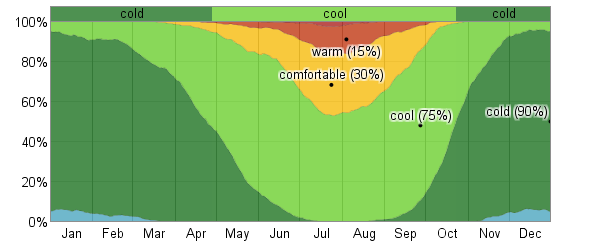
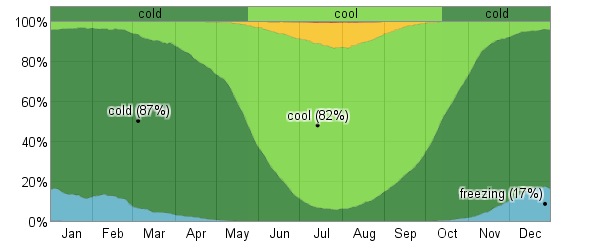
These weather charts below graphically demonstrate why fescue greens struggle when climate is not adequately considered.

Chambers Bay, Average Weather from Tacoma, WA

Fraction of Time Spent in Various Temperature Bands

The average fraction of time spent in various temperature bands: frigid (below 15°F), freezing (15°F to 32°F), cold (32°F to 50°F), cool (50°F to 65°F), comfortable (65°F to 75°F), warm (75°F to 85°F), hot (85°F to 100°F) and sweltering (above 100°F).


St. Andrews, Average Weather from Leuchars AFB, UK

Fraction of Time Spent in Various Temperature Bands

The average fraction of time spent in various temperature bands: frigid (below 15°F), freezing (15°F to 32°F), cold (32°F to 50°F), cool (50°F to 65°F), comfortable (65°F to 75°F), warm (75°F to 85°F), hot (85°F to 100°F) and sweltering (above 100°F).
Powered by Hipmunk 


Friday, May 15, 2015

USGA Greens and the California Drought

With the drought in California worsening, we should all be thinking about protecting our most precious resource, water. Many of you that have read my USGA Greens and The Emperor's New Clothes understand that I think that the USGA green construction method is flawed, in not only its basic concept but in many other ways. But now, I want to address an even more critical element, water demands.

In California and many other parts of the country, golf courses are using low quality water (high salts and bicarbonates) for irrigation. This trend will continue as more focus is put on a higher and greater use (people and food) of water resources, golf course irrigation will necessarily and rightly, be subjugated to use of inferior irrigation water. So now the question is, how do green construction methods affect water usage? Does a USGA green use more or less water than a California green or a High-tech pushup green?

On a recent trip to a desert golf course, the Superintendent was telling me about his flushing of his USGA greens. He was putting what amounted to well over 2 inches of water on the greens to flush the salts out. He may do this every two weeks. Mind you, most of this flushing water is lost, the goal is to force the salts past the "perched" or "false" water table. The USGA green holds water above the gravel blanket and salts accumulate there. They need to be flushed on a regular basis and in areas of the country where rainfall is minimal or drought is occurring, flushing is required to move salts out of the root profile. This USGA Report suggests that flushing (leaching) of greens requires an additional 20% of water. In my opinion, based upon years of observation, flushing may increase total water usage on USGA greens by something closer to 40%. Either way, we, as responsible turf managers should be thinking of ways to reduce water usage.

Well, what if there isn't a "perched" or manmade "false" water table caused by the gravel blanket? Would greens constructed in that fashion require flushing? Yes, they will but the amount of water to keep the salts moving downward and out of the root zone may be considerably less. Anecdotally, I have seen numerous golf courses that are growing the same turf species on USGA greens and non-USGA construction tees and the USGA greens required flushing with 20%-40% more water than their basic demand while the the tees did not require any flushing.

The golf course maintenance industry needs to do some "honest" research and possibly a little soul searching to determine if there is a way to construct greens that use less water. 

Tuesday, October 14, 2014

Shackelford on the Ryder Cup Task Force

We can always count on Geoff Shackelford to provide thoughtful insight into the goings on of golf. Today's blog on the Ryder Cup Task Force is just too good, so I pass it on to you.

And I couldn't resist my own comment on Geoff's post:
The Europeans still have a big chip on their shoulders and play that way.
How would a Task Force have helped Team USA at Medinah on Sunday when the US got Crenshawed?


Expendables 11: The (Ryder Cup) Task Force

The Task Force (that's capitalized) is set. There are even people on it who've been part of a winning team. Barely.
PGA of America Announces Ryder Cup Task Force

Past Captains, Players and PGA Leadership to Chart Course for Future U.S. Teams

PALM BEACH GARDENS, Fla. (October 14, 2014) – The PGA of America has announced the creation of an 11-member Ryder Cup Task Force, comprised of past Captains, players and PGA of America leadership.

The Task Force, co-chaired by PGA Vice President Derek Sprague of Malone, New York, and PGA Chief Executive Officer Pete Bevacqua of Palm Beach Gardens, Florida, will examine the entire Ryder Cup process, including the selection of United States Ryder Cup Captains; the Ryder Cup Points System; dates by which the Team is determined; dates of Captain’s selections; and the selection of Vice Captains.

The Ryder Cup Task Force was created following the 40th Ryder Cup, which concluded Sept. 28, at Gleneagles in Perthshire, Scotland, where the U.S. was defeated by Europe, 16½ to 11½.

“The Ryder Cup is our most prized competitive asset, and the PGA of America is committed to utilizing our utmost energy and resources to support one of the biggest events in all of sport,” said PGA of America President Ted Bishop. “The Ryder Cup Task Force, co-chaired by Derek Sprague and Pete Bevacqua, is an exciting and comprehensive initiative that will guide the PGA in developing the right strategy and building ongoing processes and infrastructure for future generations of U.S Teams.”

In addition to Sprague and Bevacqua, the members of the Ryder Cup Task Force are: past Captains Raymond Floyd, Tom Lehman and Davis Love III; past Ryder Cup Team members Rickie Fowler, Jim Furyk, Phil Mickelson, Steve Stricker and Tiger Woods; and PGA Secretary Paul Levy of Indian Wells, California.

“I think this is a great step by the PGA to accomplish what we all want – to win the Ryder Cup,” said Woods, a member of seven U.S. Ryder Cup Teams. “The Ryder Cup is very important to every player who has the honor to represent his country. I’m excited to be part of this group.”

The 41st Ryder Cup will be contested at Hazeltine National Golf Club in Chaska, Minnesota, in September 2016. The U.S. has lost three consecutive Ryder Cups and eight of the past 10 biennial competitions. America last won a Ryder Cup in 2008, and its last overseas victory occurred in 1993.

“Competing in a Ryder Cup is the experience of a lifetime, and serving as Captain is the ultimate honor,” said Love, a six-time Ryder Cup Team member, a 2010 Vice Captain and the 2012 U.S. Captain. “Having experienced all roles within this great event, I am deeply committed to serving once more to help direct Team USA to be a force again in the Ryder Cup.”

The Ryder Cup began in 1927. The U.S. leads the overall series, 25-13-2. However, since 1985, Europe owns a 10-4-1 advantage.
It looks like an Expendables cast. Former A-Listers, B-Listers, C-Listers and stand-ins for the former A-listers who said no.

Thursday, September 25, 2014

Presidio Renovation Continues for Suny, Zokol Golf Design

 Presidio Golf Course
Hole #14

The Par 4, 346 yd 14th after bunker renovation and green expansion, temp green in foreground

The Presidio Renovation is going very well and this hole represents the halfway point with 9 holes completed and 9 to go. Our mission at Presidio was to create an Era-appropriate renovation. This golf course has been designed, redesigned and altered by so many hands from the greats, Fowler and Simpson to Palmer to various golfing Generals that had "ideas." So, unlike many great old courses, where golf architecture historians can identify a specific period of time when the golf course was deemed to be at its best, the Presidio was in constant flux. Dick and I, along with the folks at Presidio, felt that using Fowler and Simpson and in particular Simpson for our design cues and general concepts was in keeping with and enhancing the property's golf history.

Before


This was a typical look at the Presidio with no real story told from the tee or for the approach shot, We, Suny, Zokol Golf Design, tend to favor visuals to help tell the story or to help the golfer generally identify the strategy or better yet for them to develop their own unique strategy.

Take a look at the front bunker in the before and after pictures. The bunker in the before picture was a green-side bunker, in the after photo, that bunker is some 25 feet in front of the green. This is simply a depth perception manipulation that we used to create a subtle challenge to the golfer that knows the yardage but looks at what is perceived as a green-side bunker that is actually much closer. The green was enlarged by almost 1,500 square feet and extended to the players' right with some great pin placements. A false front was added to allow players to "see" the green from the fairway. Short grass is being added around the back and right side of the green. We can't wait to see how the golfers react to the finished hole and we're looking forward to the next nine holes!

Tuesday, September 16, 2014

William Flynn on the Ball and Course Length

Joe Valentine and William Flynn

Growing up in Philly, I was a Flynn fan before anybody started talking about him. And, having worked at Merion for Richie Valentine whose father, Joe Valentine, was Flynn's construction foreman and successor as Superintendent upon Flynn's departure, I heard all of the Flynn stories along with some pretty good Dick Wilson stories. But, what I wanted to document in this post, was just how forward thinking Flynn was.

Here are his thoughts from 1927 on the ball and length of holes and golf courses.


Again the question of the ball has a great bearing on what type a certain length hole will be. Time was, and not so many years ago, when a hole 400 yards long on average ground was a good two-shot hole for the star players; now, the same hole is perhaps a drive and spade for the better class golfers.

In view of this the architect of today plans his full two-shot holes from 440 to 500 yards, depending on the character of the land and if the distance to be obtained with the ball continues to increase it will be necessary to increase the length of all holes on golf courses accordingly if the same standards of play are to be maintained.

All architects will be a lot more comfortable when the powers that be in golf finally solve the ball problem. A great deal of experi- mentation is now going on and it is to be hoped that before long a solution will be found to control the distance of the elusive pill.

If, as in the past, the distance to be gotten with the ball continues to increase, it will be necessary to go to 7,500 and even 8,000 yard courses and more yards mean more acres to buy, more course to con- struct, more fairway to maintain and more money for the golfer to fork out.