Showing posts with label Architect. Show all posts

Monday, October 20, 2025

USGA Greens and The Emperor's New Clothes

USGA Greens and The Emperor's New Clothes
February 2010, updated in 2025
Armen Suny 
sunygolf@gmail.com
303-570-2741


In Hans Christian Andersen’s classic tale, two weavers promise the Emperor a set of clothes that only the privileged or enlightened can see. There is a child that cries out “But he isn’t wearing anything at all.”


For decades now the USGA with its naked greens construction method has bullied courses and Architects into the most expensive green construction method in common use with no empirical evidence that its method is better. We are supposed to blindly go along with their green construction method despite the fact that with their tens of millions of dollars spent on research that they have not adequately investigated alternative green construction methods. Yes, there have been studies but as we all know, research has become highly politicized and results can, unfortunately, be based upon funding and future funding.


Typical USGA Greens construction can cost anywhere from twelve to fourteen dollars per square foot more than other construction methods. If we use thirteen dollars for the sake of our discussion and assume 120,000 square feet of greens, they will add $1,560,000 to the cost of construction. If we use typical “ballpark” golf development and operations numbers, each $100,000 of construction cost equates to $15.60 of greens fees. So, the USGA's pressure on Architects and the golfing public has caused an average increase in green fees of $15.60 per round. Is this good for golf? The USGA will put forth the suggestion that other green construction methods are unproven and more costly to maintain. It simply is untrue. If USGA greens are truly superior and the only way to ensure success, why don't the USGA's favorite venues for US Opens all have USGA greens?


The USGA is just like the two weavers in Andersen’s tale. The USGA green is just like the Emperor’s new clothes and I am like the child, only my cry is, “But it makes no agronomic sense and cost too much to build.” The USGA has stood by its guns with each version of its latest recasting of the specifications. Let me ask the question, what percentage of USGA greens have been rebuilt? Is the IRS correct in letting us depreciate USGA greens over 30 years? They won’t let us depreciate a push-up green. Can one green construction method be right for the entire world? It may not be right for anything! The USGA keeps telling us that the Emperor’s clothes are beautiful and that furthermore, that if we disagree that we are heretics and bad for the monarchy of golf.


Dr. Michael Hurdzan and I have had discussions for years about his righteous attempts to look at other green construction methods. His has been the lone voice in the industry to challenge the USGA green. What Mike and I have disagreed on was sterile green mixes as a growing medium. He is an advocate of straight sand California type greens and I am an advocate of green construction methods tailored to the specific agronomic conditions and always adding life and nutrient reserves to soil mixes.


Let me explain to you, that I grew up growing grass on push up greens in the Philadelphia area at Aronimink, Merion, and Rolling Green. And that then I had push up greens at Cherry Hills, inferior USGA Greens at Castle Pines, and USGA greens at Shadow Creek. I’ve grown grass in lots of different places on lots of different soil and construction types. I’ve generally found that if your water was good, there was adequate surface drainage, and you had lots of sun and air movement, that virtually any green construction method was acceptable.


As a turf consultant, I used to enjoy taking Superintendents to one of their better USGA greens and looking at the collar on the far side of the green that got very little traffic and then looking at the adjacent men’s tee that got a lot of traffic. Invariably the highly trafficked tee turf, that often had the same grass, mowing height, and schedule as the green collar was in far better condition even though it was typically built with less grade, often no drainage, and only 4-6 inches of sand. The tee construction cost 25% of the green construction and was in better shape. I used to ask Superintendents if maybe we should start building the greens like the tees so that they would be in better shape and cost less to build. They would usually pause and then start regurgitating what they had learned in school. Maybe we should teach deductive reasoning as a turf course.


What I am about to expound upon is part conjecture and all opinion on my part. The concept behind the USGA green was to build a green that could be saturated from a rain event or by over-irrigation from man and still provided an acceptable putting surface. They also wanted a green that could be irrigated with low-quality water and still support turf life.


So, logically, they piled some sandy materials on top of gravel and assumed that things would drain. Well, it didn’t work. The sand on top of the gravel created a false water table, later renamed a perched water table because it sounded better. So instead of going back to the drawing board, to create a construction method that would drain and not create a false water table, these scientists started touting the virtues of a “perched” water table and how this was the ideal method of growing grass.


Now, nowhere have I ever seen their proof for this statement that we have all come to regard as the “Holy Grail” of green construction. A false water table is not the ideal method of growing grass. In all of agriculture, other than rice patties, I am unaware of any other growth system in agriculture that relies on a false water table.


Many Superintendents have come to realize that in order for a USGA green to drain, that you have to fill up much of the big pore spaces of the sand with water until the weight of the water and gravity cause the false water table to be broken. At that time the green will start to drain, and the pore spaces will be filled with atmosphere.


Now we have many courses hooking up vacuum systems to their USGA greens to break the perched water table and pull the water out of the green. So, we designed and constructed a green with a perched water table and then because we don’t want the water there, we vacuum it out. Does my earlier statement about a deductive reasoning class being a requirement in a turf education start sounding more reasonable? Ben Franklin is quoted as saying “Common sense is uncommon.” He spent his time in Philadelphia too…maybe it’s something in the water there.


The solution to this one construction method fits all, USGA green, is to utilize our agronomic skills and design site and condition-specific green construction methods. The highest level of green construction would be utilized to grow bentgrass greens in the humid south with bad water. This is the most demanding situation that can be arrived at. What method would be utilized for this difficult situation? I would propose that the high-performance push up green construction method be used. 


High-Performance Push Up Green Method


Core Out Green to 8-10 inches below grade

Rough up or rip subsurface

Install drainage, perpendicular to grade on 10 ft. centers, and smile drains in all runoff areas

Fill drainage trenches with pea gravel

Install green mix or sand, amendments can be tilled in.


This method of construction will perform very well under adverse conditions. The tighter the subsoil, the more rainfall received and the poorer the water quality, the closer the drainage spacing.


Lesser environmental demands will require less intensive construction methods. I have built green nurseries on native soils and then topdressed them. They always performed better than the USGA greens. I have seen greens built on native soils which were ripped and then capped with a few inches of sand that have outperformed USGA greens in the same region. Every agronomic situation is different but, in my opinion, none of them need USGA greens.


Green mixes need to have life in them. The sterile environment that the USGA has dictated for too long is just bad agronomics. It is reductionism and the application of an engineering solution that is silent and even disdainful of the life that soil must have to be productive. It is hydroponics. We create a sterile soil with no nutritional reserves and then wonder why we have odd patch diseases for the first three years. If we add life and nutritional reserves to greens mixes through the incorporation of composts, natural organic fertilizers, and inoculants, we will have healthier turf and need less pesticides.


Has anybody ever considered the pollutants in the leachates from USGA greens compared to pushup greens? We should voluntarily mandate that we won’t put this contaminated leachate into drainage ways.


And now, many clubs and Superintendents are finding that the gravel/green mix interface is becoming sealed off by an iron oxide or other metal oxides, totally restricting drainage into the gravel. We've been digging these layers out for 30 years, it isn't new, and it isn't a surprise.


Now that you’ve read this, shouldn’t the Emperor put on some clothes? Shouldn’t we as responsible professionals use our expertise and experience to design region and site specific green construction methods that perform better, cost less to build, and pollute less? Perhaps the USGA can worry about rules, square grooves, anchored putters and the ball and leave the green construction methods to us.


One final question: Does the USGA have any liability for damages to clubs whose USGA Greens have failed? Probably not, since the USGA Green is merely a recommendation, not a specification, still an interesting question.

Wednesday, June 17, 2015

Fescue Follies...Not the Best Choice for Greens

The US OPEN is being played at Chambers Bay on a neo-links course which could be called moderately authentic, down to greens that were seeded to fine fescues. The romanticism of links golf with fescue greens will be short lived this week and we'll be hearing more about it as the Championship unfolds.

Why? Josh Lewis, the Superintendent, also known as the Turf Yoda has done an outstanding job preparing the golf course for this Championship. But he has been dealt a losing hand with the selection of fine fescue greens. Fine fescue greens have had little success in North America, when placed in geographic areas that have temperatures that are much higher than the successful fescue greens in European venues normally withstand. St. Andrews highest daily average temperature for the year is 66 degrees, Tacoma averages four months that the average high temperature exceeds 66 degrees. Fine fescue just isn't in its element, no matter how much we wish it would work on greens.

Poa annua, the grass that is the predominant grass on greens from coastal Northern California up through coastal Canada has invaded the greens at Chambers Bay. Not a surprise to anyone that understands turf management. So, now there are two distinctive grass types on the greens with very different growth habits. This will cause putting woes and complaints late in the day, when it will impact greens' smoothness. And if the USGA doesn't listen to the Turf Yoda and they dry the greens down too much, we'll have another 2010 season of majors when course setup becomes an issue. See: Golf Course Setup and Major Championships

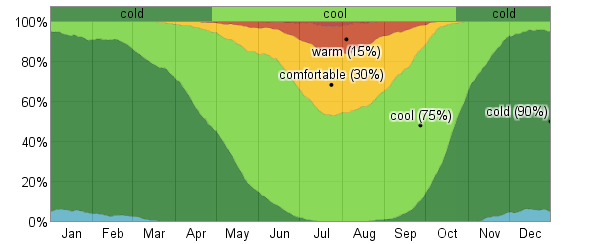
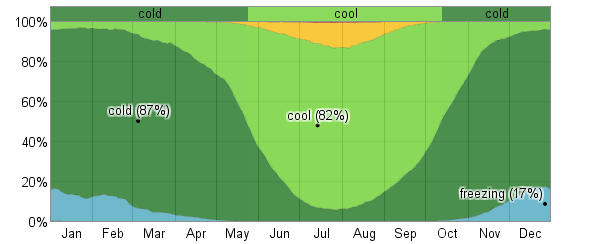
These weather charts below graphically demonstrate why fescue greens struggle when climate is not adequately considered.

Chambers Bay, Average Weather from Tacoma, WA

Fraction of Time Spent in Various Temperature Bands

The average fraction of time spent in various temperature bands: frigid (below 15°F), freezing (15°F to 32°F), cold (32°F to 50°F), cool (50°F to 65°F), comfortable (65°F to 75°F), warm (75°F to 85°F), hot (85°F to 100°F) and sweltering (above 100°F).


St. Andrews, Average Weather from Leuchars AFB, UK

Fraction of Time Spent in Various Temperature Bands

The average fraction of time spent in various temperature bands: frigid (below 15°F), freezing (15°F to 32°F), cold (32°F to 50°F), cool (50°F to 65°F), comfortable (65°F to 75°F), warm (75°F to 85°F), hot (85°F to 100°F) and sweltering (above 100°F).
Powered by Hipmunk 


Thursday, June 20, 2013

The Open and the Graduated Rough Crowd

Following the Open, I listened to commentary on the Golf Channel and PGA Tour Radio from pundits talking about how they thought that Merion should have had graduated roughs. Their opinions were that this was somehow fairer. I don't know about fairer but it certainly would have made the Open easier. First of all, the Open isn't some egalitarian tournament, it's a Championship with the implied purpose of identifying the best golfer. The US Open is supposed to test many things including one's mettle.

But let's get back to just why graduated rough does not necessarily help identify the best golfer. Now if the ideal landing area for every hole was in the middle of the fairway, then I might buy into the graduated fairway idea but at Merion the preferred landing areas are rarely in the middle of the fairway and may vary from day to day based on the pin locations and what club you are hitting. So, if the ideal landing area is on the left side of the fairway and the golfer misses the fairway to the left a few yards, the graduated  rough would aid a slightly errant shot. However, if the player hits the ball 25 yards right of the ideal landing area he could land in graduated rough. Did we help identify the best golfer?

Life is not fair, just like golf is not fair and the attempts to make golf fairer will succeed about as well as governments trying to make things fairer...perhaps we could ask the Politburo for advice on fairness.

You may want to read-

Libertarian Philosophies in Golf Course Architecture

Friday, February 8, 2013

The First Tee Feels Good

I've been at the Golf Industry Show this week. As I was riding up the elevator today, a gentleman was telling his friend about how they had raised one million dollars for the First Tee program. He was elated and speaking loudly enough that everybody heard him. And mere moments before that, I had just finished a breakfast meeting with an industry veteran who has been involved in some of the finest golf projects in the country. He felt that First Tee was a complete and utter failure at growing the game. And then later in the day I had a similar conversation with a Golf Course Architect friend; his opinion was that First Tee was a failure at growing the game. Well, this caused me to remember that The First Tee's goal is not to grow the game of golf. Let me repeat that, The First Tee's goal is not to grow the game of golf. 

Here is The First Tee's mission:

Our Mission: To impact the lives of young people by providing educational programs that build character, instill life-enhancing values and promote healthy choices through the game of golf.

And while The First Tee's mission is a noble and worthy of support, it's main purpose is not growing the game of golf. Perhaps, we should, as an industry focus on growing the game of golf. In my post about PRODUCT PLACEMENT, I look at using product placement to expose young people to the game of golf. I'm sure that there are other good ideas out there as well. But until we admit to ourselves that The First Tee program's main focus is not to create as many new golfers as possible, we will just keep sliding backwards.


Saturday, October 13, 2012

Golf's Ground Game versus Minimalist Aesthetics


Ground Attack Encouraged
A Suny Zokol Golf Design Master Plan Rendering

Faux links playability has taken over pop golf design culture. When you see some wild looking golf course with fescue waving in the air, you just believe that you will be getting a links experience. A true links experience is one that not only accepts the ground game but often calls for or even demands it to gain an advantage, while penalizing the air attack with some degree of regularity.


A Suny Zokol Golf Design Master Plan calling for the Aerial Attack


And it's always been interesting to me that a minimalist and or links looking golf course is generally assumed to be firm and fast and receptive to the ground game, purely on how it looks. Minimalist golf and the ground game are not necessarily mutually inclusive. There are many examples of great looking rugged golf courses that show all of the signs of being links like in playability but the design has greens perched up in the air and running approach shots simply cannot be played...these greens still require an aerial or conventional approach. Mind you, these course may be great but are they as receptive to the ground game as they could be or should be if they are purported to be links?

Every time you raise another green up to that dramatic site as you route the course you become less accommodating to the ground game. I don't think that we should avoid all elevated or "up" green sites but we shouldn't default to the easy drama every time either.

So the next time you play a purported links course, think about the courses receptiveness to running ground shots. Is it links golf or is it faux links?

Renderings by Maren Suny

Thursday, June 7, 2012

Golf Course Architects- Where do they come from?

Suny, Zokol Design's bunker top-line for a current renovation

Having spent my formative years listening to stories of the great golf course architects and later getting to know many of the modern golf architects and designers along with a lot of time spent on great golf courses, it's probably not a surprise that eventually I got into the design business. A great friend of mine that I consider to be the "best" golf course residential community developer in the US asked me a couple of simple questions when we were discussing my formally entering the golf course design business. His questions were-

How many world class sprinters have children that grow up to be world class sprinters?
How many golf course architects have children that grow up to be architects?

You can answer those questions yourself and draw your own conclusions.

It's interesting to me, how people have become golf course architects. In the classic era of golf in the Americas, there were the great first time amateur designers, along with those that were greenkeepers and or pros. There were standouts in each of these groups. Its tough to beat Hugh Wilson, George Crump, and William Flynn. It's not very difficult to figure out where I grew up and what I like.

Today's routes to become a golf course architect are to be born into the family business, be a PGA Tour player, like my partner Dick Zokol, study landscape and golf course architecture, there are even a couple of greenkeeper types like me, there are operator types that started in the golf construction business, and then there are today's amateurs...the golf writers and golf architecture historians.

In each of these groups there are those that just seem to have it and then the rest of them. I'm not talking about marketing ability, we all understand that there have been some brilliant marketers in the golf architecture business. But what sets the others apart? What sets them apart is the gift that they were born with. Golf course architecture is not a science or a math that can be learned solely from a book. The talent required to become a golf course architect/designer is based on the artistry that you are born with and develop and more than just a touch of common sense.

Friday, February 3, 2012

Golf's Future Growth...Product Placement


Let's face it, kids just aren't that interested in playing golf and it appears as if we will lose an entire generation of golfers. Most kids, in all probability, think that golf is a game for old men. We, as an industry, need to find ways to make golf appealing to kids. Golf organizations have been spending tens of millions of dollars a year trying to attract kids to golf but have failed. The economy and rehashing the same old ideas for growing the game of golf do not bode well for our sport. We need to find new and innovative ways to make kids want to know more about or even, dare I say, play golf.

First Tee and Tiger Woods were going to save golf, remember. And now, The PGA of America is going to save golf with Golf 2.0. I hope that we get some more software updates for Golf 2.0 before it's too late. I'm just afraid that it's going to be more of the same bureaucracy driven mediocrity that ends up making us feel like we are doing something, even if it is the same old thing. It's time to try a entirely new 21st Century approach.

Let me propose a new idea, Product Placement or Embedded Marketing to promote golf. It has worked for everything from soft drinks to automobiles and more; it can and will work for golf.  Pay the  network, studios, Executive Producers or whomever to place golf and golf characters into their youth oriented sitcoms and movies. Expose tens of millions of children to golf through television shows and movies that they are already watching. This way we won't need to change kids' behaviors to expose them to golf, they'll get our message in their own family rooms. And then of course since we would be buying this Product Placement, we would dictate that the golf character be one of the more popular, hip, cool, dope characters on the show. If we can create mainstream youth culture characters that are golfers, kids will begin to think of golf as part of the norm for their peer group.

There are undoubtably many ways to attract young people to the game of golf; as an industry, we need to constantly reevaluate and better our efforts. If we don't start thinking about growing the game of golf in new youth oriented ways, it won't grow and it will truly become a game for old men.

Monday, January 2, 2012

More Einstein on Golf Course Architecture

Einstein, if he had played golf, would have ended up a designer...and what would he have thought of modern design?


My partner in the Golf Course Design business, Richard Zokol, sent me this Einstein quote after he had read my EINSTEIN and GOLF COURSE ARCHITECTURE post, "The intuitive mind is a sacred gift and the rational mind is a faithful servant. We have created a society that honors the servant and has forgotten the gift." As it turns out we were both reading Einstein quotes at the same time. Zokol works hard to keep his intuitive side running roughshod over his logical side...and as for me, I live in both worlds.

The intuitive mind in golf course architecture has seen a rebirth in the last fifteen years or so. But let's be very clear, the sacred gift (intuitive mind) can use a healthy dose of the faithful servant (rational mind) if any design is going to be truly good. The problem with modern golf course architecture is that design and renovation have become far more rational and conventional than intuitive and original.

The intuitive mind should be the overwhelming force in any design with the rational mind reviewing the decisions and concepts to insure that they have captured the goals of the design. I have opined in my TREATISE ON GOLF COURSE ARCHITECTURE about this subject:


There is a difference between things, whether it be art, music, movies, man made landscapes, building architecture, and even golf course architecture that garner attention for short periods of time and others which become classics. What causes us to like something forever versus becoming enthralled for a short period of time and then losing interest? Why is it that some golf courses capture our attention to the point that we could play the same golf course over and over again and never tire of it, while other courses initially grab our attention but seem somewhat shallow in the long run? 
Perhaps it is a nature based originality that sets one golf course apart from another, that allows it to be considered a "classic". When those other courses, that are formulaic and impose preset artificial conditions and constraints upon any piece of ground that they are built upon, are considered in the long run as less than "classic", is it really any wonder? Can golf architecture avoid falling into formulaic convention? Through the Anarchy of nature it can.
We are all slaves to convention at some level. We constantly hear and talk about thinking out of the box. Golf architecture suffers from all of the same problems when it comes to shaking off convention and thinking out of the box.

To me the intuitive mind that Einstein talks about is the ultimate definition of being one with nature and all of its variability and anomalies. And the rational mind is all too often the convention that sneaks into our psyche and causes us to lose our creative fortitude to embrace our intuitive mind.

The lack of intuitive design in today's golf course architecture is mind numbing and the playability of modern golf continues to have a sameness to it, no matter what aesthetic treatment is utilized. It has become popular today to push some tees back, scallop bunker edges using native/fescues or to create maintained steep grass bunker banks and flat sand bottoms. Oh yeah, don't forget the runoff areas, it's considered cutting edge strategy to add short grass areas around greens that only take the ball away from the putting surfaces. And that's it, yep, no interest in enhanced and varied strategic options, just more of the same; the sacred gift of intuition is nowhere to be found and the faithful servant, rational mind, continues to be honored.

So, designers in general redo bunkers and push some tees back while improving aesthetics. Their rational minds won't even let them think about a paradigm shift in strategy through enhanced and varied playability options and strategies. The problem with this standard approach is that these courses continue to offer limited shot options and strategies which make golf less interesting and less playable. The "gift" is still missing, even when the courses look as if they should offer options in playability, they don't because they still require the air game on most approach shots and repetitive strategy off of the tee hole after hole and course after course...


Einstein believed that the intuitive or the right brain, was critical in achieving great things and that the rational or left brain, while necessary, had to be utilized in conjunction with intuition to avoid the mundane. Is today's golf course architecture more intuitive or rational?

Wednesday, July 7, 2010

Runoff Areas- Rewriting Golf Course Architecture History

In the last couple of weeks we have seen runoff areas featured at Pebble Beach during the US Open and at Aronimink for a PGA Tour event. Some modern golf course architects and so called restoration experts have convinced golf's oligarchy that runoff areas are historically accurate and were prevalent features for some golf course designers of the "Golden Era" of architecture.

In the 1920s and the 1930s there were no runoff areas on golf courses. It's just that simple, the revisionist golf course architecture history is purely a fabrication. How do I know this? Good question and the answer will appear self evident. Fairway mowing heights in the 20s and 30s were generally between 1 and 1.5 inches or about the same as today's intermediate rough height. Does a ball roll very far in intermediate rough? No, it settles down very quickly. It really is that simple, the great designers of the 20s and 30s could have wanted to have runoff areas but the mowing heights didn't allow it to happen. Greens in the 20s and 30s were maintained at 3/16 to 1/4 of an inch or about the same as the most closely cropped runoff areas of today.

Now mind you, I really like short grass around putting surfaces, although I have difficulty understanding why most modern designers only utilize short grass to take the ball away from the green. It seems as if a balance of run-on areas and runoff areas would be more interesting golf architecture but that's another blog for another time.

Having worked at Aronimink some thirty plus years ago, I really enjoyed seeing the golf course on TV. I did golf course setup there for three years and knew the golf course fairly well. I thought the changes were an improvement to the golf course but to call them historically correct in regard to playability is just flat wrong.

Below are two articles from the 1930s that talk about fairway mowing heights. We might assume that in the 1920s the mowing heights were even higher.

1933. The Bulletin of the United States Golf Association Green Section. May. 13(3): p. 86-87.

Thursday, February 4, 2010

Golf Sketches and Clay Models versus Photoshop and Topos


Digitally manipulated photos, to me appear to be emotionless and soulless representations of golf. It may be an indication of the left brain dominated thought process typical of engineers versus the right brain dominated thought process of the artist.

I have started sketching some concepts for a potential client and even some existing golf holes like the picture in the prior post of Sagebrush. Drawing is something that I haven't done in the last 40 years. I have been trying to draw 15 minutes or so each day for the last few weeks.


The clay model is another excellent tool to convey an idea of what the golf should or could look like. This can be accomplished quickly and everyone from the client to the shaper, if you aren't doing it yourself, will understand what the form will look like. This is also a tremendous tool for renovations so that the client fully understands the changes as they really will be, versus looking at pretty green grass Photshopped pictures that don't convey the entire concept or worse yet, lack thereof.

The image above is the model that the 13th at Sagebrush was built from. During the shaping when we went back to the tee, it was apparent that we should get rid of the pot bunker in front and make the right bunker larger to keep the front of the green open and encourage the golfer to try and drive this reachable par 4.