Showing posts with label Golf. Show all posts

Monday, October 20, 2025

USGA Greens and The Emperor's New Clothes

USGA Greens and The Emperor's New Clothes
February 2010, updated in 2025
Armen Suny 
sunygolf@gmail.com
303-570-2741


In Hans Christian Andersen’s classic tale, two weavers promise the Emperor a set of clothes that only the privileged or enlightened can see. There is a child that cries out “But he isn’t wearing anything at all.”


For decades now the USGA with its naked greens construction method has bullied courses and Architects into the most expensive green construction method in common use with no empirical evidence that its method is better. We are supposed to blindly go along with their green construction method despite the fact that with their tens of millions of dollars spent on research that they have not adequately investigated alternative green construction methods. Yes, there have been studies but as we all know, research has become highly politicized and results can, unfortunately, be based upon funding and future funding.


Typical USGA Greens construction can cost anywhere from twelve to fourteen dollars per square foot more than other construction methods. If we use thirteen dollars for the sake of our discussion and assume 120,000 square feet of greens, they will add $1,560,000 to the cost of construction. If we use typical “ballpark” golf development and operations numbers, each $100,000 of construction cost equates to $15.60 of greens fees. So, the USGA's pressure on Architects and the golfing public has caused an average increase in green fees of $15.60 per round. Is this good for golf? The USGA will put forth the suggestion that other green construction methods are unproven and more costly to maintain. It simply is untrue. If USGA greens are truly superior and the only way to ensure success, why don't the USGA's favorite venues for US Opens all have USGA greens?


The USGA is just like the two weavers in Andersen’s tale. The USGA green is just like the Emperor’s new clothes and I am like the child, only my cry is, “But it makes no agronomic sense and cost too much to build.” The USGA has stood by its guns with each version of its latest recasting of the specifications. Let me ask the question, what percentage of USGA greens have been rebuilt? Is the IRS correct in letting us depreciate USGA greens over 30 years? They won’t let us depreciate a push-up green. Can one green construction method be right for the entire world? It may not be right for anything! The USGA keeps telling us that the Emperor’s clothes are beautiful and that furthermore, that if we disagree that we are heretics and bad for the monarchy of golf.


Dr. Michael Hurdzan and I have had discussions for years about his righteous attempts to look at other green construction methods. His has been the lone voice in the industry to challenge the USGA green. What Mike and I have disagreed on was sterile green mixes as a growing medium. He is an advocate of straight sand California type greens and I am an advocate of green construction methods tailored to the specific agronomic conditions and always adding life and nutrient reserves to soil mixes.


Let me explain to you, that I grew up growing grass on push up greens in the Philadelphia area at Aronimink, Merion, and Rolling Green. And that then I had push up greens at Cherry Hills, inferior USGA Greens at Castle Pines, and USGA greens at Shadow Creek. I’ve grown grass in lots of different places on lots of different soil and construction types. I’ve generally found that if your water was good, there was adequate surface drainage, and you had lots of sun and air movement, that virtually any green construction method was acceptable.


As a turf consultant, I used to enjoy taking Superintendents to one of their better USGA greens and looking at the collar on the far side of the green that got very little traffic and then looking at the adjacent men’s tee that got a lot of traffic. Invariably the highly trafficked tee turf, that often had the same grass, mowing height, and schedule as the green collar was in far better condition even though it was typically built with less grade, often no drainage, and only 4-6 inches of sand. The tee construction cost 25% of the green construction and was in better shape. I used to ask Superintendents if maybe we should start building the greens like the tees so that they would be in better shape and cost less to build. They would usually pause and then start regurgitating what they had learned in school. Maybe we should teach deductive reasoning as a turf course.


What I am about to expound upon is part conjecture and all opinion on my part. The concept behind the USGA green was to build a green that could be saturated from a rain event or by over-irrigation from man and still provided an acceptable putting surface. They also wanted a green that could be irrigated with low-quality water and still support turf life.


So, logically, they piled some sandy materials on top of gravel and assumed that things would drain. Well, it didn’t work. The sand on top of the gravel created a false water table, later renamed a perched water table because it sounded better. So instead of going back to the drawing board, to create a construction method that would drain and not create a false water table, these scientists started touting the virtues of a “perched” water table and how this was the ideal method of growing grass.


Now, nowhere have I ever seen their proof for this statement that we have all come to regard as the “Holy Grail” of green construction. A false water table is not the ideal method of growing grass. In all of agriculture, other than rice patties, I am unaware of any other growth system in agriculture that relies on a false water table.


Many Superintendents have come to realize that in order for a USGA green to drain, that you have to fill up much of the big pore spaces of the sand with water until the weight of the water and gravity cause the false water table to be broken. At that time the green will start to drain, and the pore spaces will be filled with atmosphere.


Now we have many courses hooking up vacuum systems to their USGA greens to break the perched water table and pull the water out of the green. So, we designed and constructed a green with a perched water table and then because we don’t want the water there, we vacuum it out. Does my earlier statement about a deductive reasoning class being a requirement in a turf education start sounding more reasonable? Ben Franklin is quoted as saying “Common sense is uncommon.” He spent his time in Philadelphia too…maybe it’s something in the water there.


The solution to this one construction method fits all, USGA green, is to utilize our agronomic skills and design site and condition-specific green construction methods. The highest level of green construction would be utilized to grow bentgrass greens in the humid south with bad water. This is the most demanding situation that can be arrived at. What method would be utilized for this difficult situation? I would propose that the high-performance push up green construction method be used. 


High-Performance Push Up Green Method


Core Out Green to 8-10 inches below grade

Rough up or rip subsurface

Install drainage, perpendicular to grade on 10 ft. centers, and smile drains in all runoff areas

Fill drainage trenches with pea gravel

Install green mix or sand, amendments can be tilled in.


This method of construction will perform very well under adverse conditions. The tighter the subsoil, the more rainfall received and the poorer the water quality, the closer the drainage spacing.


Lesser environmental demands will require less intensive construction methods. I have built green nurseries on native soils and then topdressed them. They always performed better than the USGA greens. I have seen greens built on native soils which were ripped and then capped with a few inches of sand that have outperformed USGA greens in the same region. Every agronomic situation is different but, in my opinion, none of them need USGA greens.


Green mixes need to have life in them. The sterile environment that the USGA has dictated for too long is just bad agronomics. It is reductionism and the application of an engineering solution that is silent and even disdainful of the life that soil must have to be productive. It is hydroponics. We create a sterile soil with no nutritional reserves and then wonder why we have odd patch diseases for the first three years. If we add life and nutritional reserves to greens mixes through the incorporation of composts, natural organic fertilizers, and inoculants, we will have healthier turf and need less pesticides.


Has anybody ever considered the pollutants in the leachates from USGA greens compared to pushup greens? We should voluntarily mandate that we won’t put this contaminated leachate into drainage ways.


And now, many clubs and Superintendents are finding that the gravel/green mix interface is becoming sealed off by an iron oxide or other metal oxides, totally restricting drainage into the gravel. We've been digging these layers out for 30 years, it isn't new, and it isn't a surprise.


Now that you’ve read this, shouldn’t the Emperor put on some clothes? Shouldn’t we as responsible professionals use our expertise and experience to design region and site specific green construction methods that perform better, cost less to build, and pollute less? Perhaps the USGA can worry about rules, square grooves, anchored putters and the ball and leave the green construction methods to us.


One final question: Does the USGA have any liability for damages to clubs whose USGA Greens have failed? Probably not, since the USGA Green is merely a recommendation, not a specification, still an interesting question.

Friday, July 25, 2025

Organic Green Shapes, Lost in Time

Many of the great old golf courses, when built, had remarkable greens and while the contours may still be with us yet today, the green shapes are not. Green shapes, over the decades, have devolved into unimaginative ovals and egg shapes. Just how these wonderful organic shapes were lost will become evident with a bit of understanding about the nature of golf course maintenance. But what may be more important and relevant is just how much these changes have affected modern golf course design when it comes to green shapes.

Look at these Donald Ross plans from Aronimink Golf Club. These are some wonderful shapes that are anything but the routine shapes that plague most courses today. I know these greens at Aronimink a little bit, having worked there back in the 70s and the while the contours were still there, the shapes from Ross's plans were simply gone. The recent renovation there went a long way to restoring these great greens. 

Aronimink Golf Club #13


Aronimink Golf Club #3

So what happened? Well, that's pretty simple, during the 1960s when courses almost all used triplex mowers, either completely or during the "shoulder" seasons and the triplexes couldn't follow the cleanup pass (outside ring cut) of the greens because of their turning radius. Along with that, anyone that has ever mowed a green knows that it's a cardinal sin to scalp the collar while mowing the cleanup pass. Those two factors when combined with superintendents that weren't constantly monitoring the greens' edges resulted in today's mundane green shapes on most of our great old courses.

In many cases more than 10% of the putting surface was "lost" and along with that, some great pin positions. And what makes matters even worse, is that today's golf course designers grew up on dumbed downed green shapes and their point of reference when designing or renovating greens is just as dumbed down . . . modified circle, oval and egg shapes on most greens.

Designers should be careful in creating and rediscovering organic shapes for greens lest green shapes become caricatures. Organic shapes for greens should not be forced, they need to be tied to landforms and be consistent with the design.

Friday, April 25, 2025

Intuitive Golf Course Architecture

Intuitive Golf Course Architecture is how the great courses of the Golden Age of Design were built. Intuitive Golf Architecture validated by logic, produces special golf courses. These golf courses "feel" better than the conventional, paint by numbers, formulaic courses that are driven by rigid strategic parameters.

Deepak Chopra stated that, "Logic relies on reasoning, it relies on cause and effect relationships, its more or less linear. Intuition goes into a deeper part of yourself, which is your soul. Therefore intuition is a form of intelligence that is contextual, it takes everything into account, it is nurturing, it doesn't have a win lose orientation. It literally eavesdrops on the mind of the universe."

Zokol and I (Suny, Zokol Golf Design) are, in our souls, Intuitive Golf Course Designers. We are "feel" guys that look at land and the golf course in context with the surroundings and postulate the potential playability of what feels right. Playability is a byproduct of this intuitive connection process and is never overlooked. Quirkiness is not a disqualification by any means and originality is absolutely a plus.

Recently, while working with a client on reno/restoration of a property, we were slightly perplexed over starting the project on arguably one of the more architecturally challenged holes. At the green we eliminated the symmetry of bunkering and created a green/surrounds that is dissimilar to anything either of us remembers seeing or hearing about. We believe that it may be original; originality was not the intent but the byproduct of our intuition. The design captured the overall sense, feel and historic era of the property. The design concept was hashed out on site with clay models and followed up with hand drawn sketches, a step back to the process of the Golden Age when plasticine models were often the norm. We believe in creative collaboration along with open, frank discourse and seek it from others. Creative discourse is critical to our design process and some ideas that seem to be just too extreme may have unique and interesting aspects that can and often do enhance the end results.

Does it seem as if the conventional/analytical designers who start with preconceived notions are open to creative input through discourse? Do their golf courses suffer for it? Are golfers slighted by the one-dimensional aspect of logic/fear/reason/linear based golf course design? Do their golf courses ever reach down into your soul? Are they compelling? Is it possible to apply intuition to a logic-based design? Is that why some designer's courses look the same no matter what the surroundings?

Zokol and I believe that Intuitive Golf Course Design validated by logic and reason produces golf courses that are superior in every way.

A sketch of a current project from the left side of the green complex.

Friday, March 28, 2025

Golf Architecture's Uphill Battle

Has anyone noticed that there is a shortage of uphill Par 3s on modern Golf Courses? Today's designers will do just about anything while routing a golf course to avoid an uphill Par 3. Maybe you don't get to wear a plaid sport coat if you make uphill Par 3s or it could be that CAD programs used for golf design have a virus that is triggered by uphill 3s.

Modern designers venture onto level ground to design a Par 3 with little trepidation and literally salivate when they see that downhill ground for a lovely Par 3. And let's face it, really, how tough is it, to design a pretty downhill Par 3 and instill it with some kind of interesting strategy? Not exactly nuclear physics is it? But when it comes to the uphill Par 3, there just aren't many new ones out there. Of course, they can't be severely uphill but they can go up a moderate slope and create some real interest and a unique challenge.

Just look at the golf courses built in the last thirty years and at the plethora of downhill Par 3s. Some golf courses have 3 or 4 downhill Par 3s with another that may be level. At some point, the sameness of too many downhill Par 3s on these courses starts to become boring, no matter how good the architecture is and how aesthetically pleasing they are. It's just more of the same. Where are the great modern uphill Par 3s? Golf historians may look back at this era of architecture with disdain for its propensity to avoid uphill Par 3s.

In routing courses, designers often use the Par 3 as a "connector" between Par 4s and 5s. It's easy to use the Par 3 in those sticky parts of a routing and it is especially helpful when there is a significant sharp downhill grade change. These kinds of sharp downhill grade changes are much more difficult to deal with on Par 4s and 5s. Its easy and it makes sense to use a downhill Par 3 for continuity in the routing. Most modern golf architecture utilizes a golf car between holes to deal with uphill elevation changes and would never consider a Par 3 as a "connector" to go uphill, even when there may be a great opportunity for an interesting and original uphill Par 3.

Uphill Par 3s may be the most challenging design element in Golf Course Architecture and from a golfer's perspective; they are the most perplexing of holes and can really test one's mettle. We're dealing with a one shotter with much less visibility than we are used to or feel comfortable with. It is one of the more interesting challenges that one can have on a tee and maybe even a bit similar to the blind tee shot where you just know that there is fairway where you hit your ball, but you're really not positive.

Tackling the uphill Par 3 is perhaps one of the more, if not the most interesting and challenging aspects of golf course design. Creativity and a measure of intestinal fortitude are mandatory for those that venture into that uphill battle. Try explaining the benefits of the uphill Par 3 to a client sometime. But the end result is absolutely worth it. Think about those times that you've stood on the tee of an uphill Par 3 and what was going through your head before the shot and even as you approached the green after hitting what you believed to be the perfect tee shot.

Another Sketch

Friday, December 27, 2024

Vineyards for Golf Course Water Conservation


As a prelude to these thoughts, let me tell you about a day that Dick Zokol and I spent with a developer and his team six years ago. We spent the day looking at a beautiful rugged site with enough room for a golf course, residential community and an organic vineyard. That day and that concept have stuck with us. So naturally when dealing with two clients in the last month that are considering turf reductions to reduce water usage, we started thinking about different ways to achieve those goals:

Drought in the Western US is having and will continue to have a huge impact on existing golf courses. There are many water districts that are paying water users, including golf courses, to remove irrigated turf areas. We can pretend to be stewards of the land by putting up more birdhouses or we can dig in and set about reducing water consumption on golf courses. This provides unique challenges for aesthetics and playability along with an opportunity for Wine?

Wine, yes wine, instead of taking the usual route of replacing high water use turf with native type grasses or vegetation, maybe it's time to convert those ares into vineyards. Imagine those excessive  out of play turf areas, planted to grapes.

There have been new residential developments that included golf courses and vineyards but using grapes as a means of reducing water usage on existing golf courses offers a wonderful opportunity for a sensible and gastronomically pleasing means of achieving sustainability.

Vineyards in California typically use between 80,000 and 160,000 gallons of water per acre versus turf that could use  between 750,000 and 1,500,000 gallons per acre. Water conservation is critical to the West and Vineyards may have a place in these efforts in reducing water usage on golf courses.

It's incumbent upon Golf Course Designers to help clubs and courses reduce their demands for precious water resources through innovative thinking. We already have the ability to provide options in playability so that the golf experience, not only, isn't diminished but in all probability, enhanced through Design/Conservation planning. Now we have another vegetative tool to help achieve that goal.

Can you play out of this?

How about this?


Water conservation efforts in some communities have proved unpopular and often times ran amok of the Homeowners Association's rules and regulations. Even property values can be affected by what is perceived to be less appealing landscapes when green grass is no longer wall to wall. But take that same  effort and convert a high water use turf area to a vineyard and quite possibly, you can play golf, drink wine, and conserve water; everyone wins.

Our efforts in Golf Course Architecture must continue to focus on great, immensely playable, sustainable golf!

Sunday, March 6, 2016

Zokol on Golf's Mind Game

Becoming Disco Dick: ‘This could be heaven or this could be hell’

dick zokol

Would you risk being ridiculed to play better golf?
Richard Zokol did.
On our latest Swing Thoughts podcast, Zokol talks about taking a risk that not only propelled him into the lead of a PGA Tour event, but also helped him to learn how to use his mind to play better golf.
On Episode Eight of ST, the Canadian Golf Hall of Famer tells engaging stories about his 20-year adventure on the PGA Tour and shares great insights that can help you play better golf.
The native of White Rock, British Columbia was a rookie on the tour in 1982, but by July he had still failed to make a cut. “I was climbing the walls with frustration because I wasn’t able to perform,” he said. “I was playing well but my thoughts were getting me ahead of me.”
At the Western Open in Chicago, he bought a Walkman, which for you younger folks was a portable cassette tape player and radio that fit on your belt that you listened to with headphones.
He was sure that listening to music while playing might help him stay calm, but the idea of wearing headphones during a PGA Tour event was “radical. I thought, What if I shoot 80?”
He “chickened out” in Chicago and didn’t wear the headphones. He missed yet another cut and kicked himself for failing to take the risk.
Feeling extremely nervous, Zokol teed off in the first round in Milwaukee on the 10th tee at 7:30 a.m. “with no one around.” He let partners Ronnie Black and Larry Rinker get ahead of him, unzipped his golf bag and put the headphones on. The Eagles were playing; he thinks the song was Hotel California, which features the perfectly ominous line for the risk he was taking: “This could be heaven or this could be hell.”
Coming down his 18th hole, he was seven-under par and leading the tournament. He could tell his headphones were generating some excitement because of all the photographers snapping his picture, yet he felt calm. “I was in my own little world.”
Zokol was chill but the PGA Tour was alarmed. Tour officials phoned the United States Golf Association for a ruling and learned that it was legal to wear headphones if the player was listening to music.
He shot 69 and 70 in the second and third rounds, and came down the stretch Sunday in the lead with four shots to play. Alas, the 23-year-old rookie became overwhelmed when he thought about winning and he made double-bogey and bogey to finish T5.
Regardless, Zokol’s bold move paid off. He gave himself a chance to win, and the media excitedly told the story, christening him Disco Dick and vaulting him into the limelight.
More importantly, he became more competitive. “I wore headphones on tour for a year before I stopped. I needed to learn how to control my thoughts without listening to music. I didn’t want to be dependent on the distraction that the Walkman provided,” said Zokol who won two PGA Tour events in 1992, including the Milwaukee Open.
Zokol said the Walkman experiment launched him on a journey of self-discovery, working with mental coaches, learning how to meditate and developing skills in the mental game, which remains a passion since his retirement from the tour. He now works as Golf and Real Estate Specialist at Predator Ridge Resort in Vernon, British Columbia.
“I discovered just how much psychology is involved in the game,” said Zokol, who is working on bringing a technology product to market to help players to evaluate their decision-making and execution.
“What most golfers don’t realize is that the best golf equipment they can ever have is their mind. But not too many people realize this premise.”

Wednesday, January 20, 2016

Suny Turns the Tables on the Turfgrass Zealot, Dave Wilber


If you want to learn more about the Turfgrass Zealot, Dave Wilber, listen to his show but with a twist; I'll be interviewing Dave. You'll learn more about Dave as a person and as one of the preeminent eco-ag turf consultants. Many of today's turf soil and fertility concepts and products are based on Dave's efforts in consulting and educating Superintendents. Listen here:

Wednesday, December 9, 2015


GEOFF SHACKELFORD, has it right again!

USGA, ASGCA Partnering For Pro-Bono Design Services

I know what you're thinking, the USGA has been changing courses free of charge for decades. 
But this is actually a program geared toward courses no hosting championships and hosting the everyday golfer. Certainly something like this is a long overdue use of the Green Sectionand of architects, though I do fear for courses receiving recommendations designed to generate pricey re-construction of greens to USGA specs.

What also is missing: the USGA maybe commiting some of its $400 million in reserve to the occassional restoration of a worthy muni. Oh well, a great start...
FOR IMMEDIATE RELEASE

USGA, AMERICAN SOCIETY OF GOLF COURSE ARCHITECTS ANNOUNCE PARTNERSHIP
TO SUPPORT PUBLICLY ACCESSIBLE GOLF COURSES

FAR HILLS, N.J. (Dec. 8, 2015) – The United States Golf Association (USGA) and the American Society of Golf Course Architects (ASGCA) have launched a collaborative program to help publicly accessible golf facilities improve the design and maintenance of their courses and deliver a better experience for their customers.

Combining the expertise of ASGCA member architects and USGA agronomists, scientists and researchers, the program will provide pro bono consulting services to facilities that need assistance to achieve their goal of making  their layouts more enjoyable and reducing their maintenance costs.

“Course design and maintenance form the foundation of a golf facility’s operations,” said Mike Davis, USGA executive director. “With the knowledge that the ASGCA and USGA can offer, more publicly accessible facilities will be able to strengthen this base, while promoting resource efficiency, a better golf experience and a stronger connection to the local community.”

Starting today, facilities can submit an application for the service, which will include an on-site evaluation, professional analysis and a report outlining recommendations for improvement. Recommendations can cover course design, agronomy, environmental stewardship and golf course operations, with the goal of lowering costs while also improving the golfer experience.

“The ASGCA, along with the ASGCA Foundation led by John LaFoy, is pleased to partner with the USGA on this initiative,” said Steve Smyers, president of the ASGCA. “Golf facilities have long benefited from the efforts of ASGCA members and USGA agronomists. Collaboration between our experts will have a positive impact on the facilities we support. ASGCA members are excited and proud to bring their expertise to this program.”

Interested facilities must submit an application by one of three deadlines over the coming year: March 15, Aug. 15 or Dec. 15. The application can be found here.

Canal Shores Golf Course, a community-owned and operated facility in Evanston, Ill., is the first course to receive a pro bono evaluation through the program.

“This has been an incredible opportunity,” said Jason Way, of the Canal Shores planning committee. “We have some great ideas about how to improve the course, but the assistance from the USGA and the ASGCA allows us to get past the initial planning process, so we can move forward with our vision for making Canal Shores a multi-use community green space that the maximum number of people can enjoy.”

Selected facilities must express a willingness to carry out the recommendations from the USGA and ASGCA. Facilities will be expected to track and report the effectiveness of their improvements based on specific metrics.

A video that shares more detailed information on the program and Canal Shores can be found at usga.org via the following link.

The partnership complements the USGA’s course consulting services, which deliver implementable solutions to support a healthier future for golf facilities. In October, the USGA also announced a five-year master research partnership with the University of Minnesota to study and develop solutions to golf’s present and future challenges, including environmental sustainability.
The video features Hunki Yun explaining the program from the USGA's new Far Hills TV set. Love the echo chamber vibe!

Here is the application page.

My Comments:
Geoff,

I don't know whether we should laugh or cry. It's kind of like hearing those words, "We're the government and we're here to help." "We're the USGA and the ASGCA and we're here to help." A bit of skepticism is warranted.

Hopefully, these "agronomists" will steer courses away from building USGA greens. In my opinion, the USGA green is a costly mistake and is the highest source of pollution per square foot of turf in the world.

My thoughts on USGA greens:

http://aggca.blogspot.com/2010/02/usga-greens-and-emperors-new-clothes.html
12.8.2015 | Unregistered CommenterArmen Suny

Thursday, July 16, 2015

Richard Zokol Interview on St. Andrews and the Open


Canadian Golf Hall of Fame member Dick Zokol shares his extensive experience on the Old Course, including one story about Shetland ponies in the Road Bunker that we won’t go into here, Jordan Spieth, Dustin Johnson, Rickie Fowler, Tiger Woods and all things British Open.
To listen to that conversation with Hutch, click below.

Friday, June 26, 2015

Suny on Turfnet Radio with Dave Wilber

Yesterday, I was on Turfnet Radio with Dave Wilber, talking design, renovation, fescue greens, US OPEN, executive search, it was a wild ride!


Wednesday, June 17, 2015

Fescue Follies...Not the Best Choice for Greens

The US OPEN is being played at Chambers Bay on a neo-links course which could be called moderately authentic, down to greens that were seeded to fine fescues. The romanticism of links golf with fescue greens will be short lived this week and we'll be hearing more about it as the Championship unfolds.

Why? Josh Lewis, the Superintendent, also known as the Turf Yoda has done an outstanding job preparing the golf course for this Championship. But he has been dealt a losing hand with the selection of fine fescue greens. Fine fescue greens have had little success in North America, when placed in geographic areas that have temperatures that are much higher than the successful fescue greens in European venues normally withstand. St. Andrews highest daily average temperature for the year is 66 degrees, Tacoma averages four months that the average high temperature exceeds 66 degrees. Fine fescue just isn't in its element, no matter how much we wish it would work on greens.

Poa annua, the grass that is the predominant grass on greens from coastal Northern California up through coastal Canada has invaded the greens at Chambers Bay. Not a surprise to anyone that understands turf management. So, now there are two distinctive grass types on the greens with very different growth habits. This will cause putting woes and complaints late in the day, when it will impact greens' smoothness. And if the USGA doesn't listen to the Turf Yoda and they dry the greens down too much, we'll have another 2010 season of majors when course setup becomes an issue. See: Golf Course Setup and Major Championships

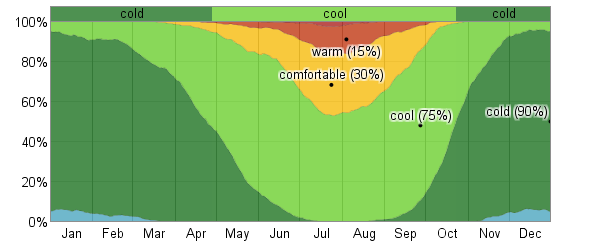
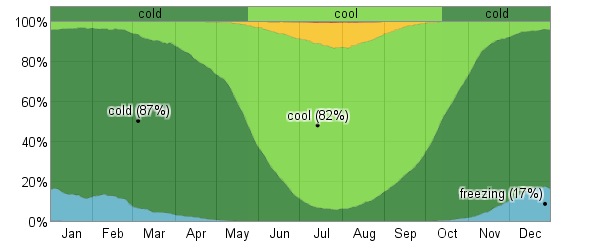
These weather charts below graphically demonstrate why fescue greens struggle when climate is not adequately considered.

Chambers Bay, Average Weather from Tacoma, WA

Fraction of Time Spent in Various Temperature Bands

The average fraction of time spent in various temperature bands: frigid (below 15°F), freezing (15°F to 32°F), cold (32°F to 50°F), cool (50°F to 65°F), comfortable (65°F to 75°F), warm (75°F to 85°F), hot (85°F to 100°F) and sweltering (above 100°F).


St. Andrews, Average Weather from Leuchars AFB, UK

Fraction of Time Spent in Various Temperature Bands

The average fraction of time spent in various temperature bands: frigid (below 15°F), freezing (15°F to 32°F), cold (32°F to 50°F), cool (50°F to 65°F), comfortable (65°F to 75°F), warm (75°F to 85°F), hot (85°F to 100°F) and sweltering (above 100°F).
Powered by Hipmunk 


Friday, May 15, 2015

USGA Greens and the California Drought

With the drought in California worsening, we should all be thinking about protecting our most precious resource, water. Many of you that have read my USGA Greens and The Emperor's New Clothes understand that I think that the USGA green construction method is flawed, in not only its basic concept but in many other ways. But now, I want to address an even more critical element, water demands.

In California and many other parts of the country, golf courses are using low quality water (high salts and bicarbonates) for irrigation. This trend will continue as more focus is put on a higher and greater use (people and food) of water resources, golf course irrigation will necessarily and rightly, be subjugated to use of inferior irrigation water. So now the question is, how do green construction methods affect water usage? Does a USGA green use more or less water than a California green or a High-tech pushup green?

On a recent trip to a desert golf course, the Superintendent was telling me about his flushing of his USGA greens. He was putting what amounted to well over 2 inches of water on the greens to flush the salts out. He may do this every two weeks. Mind you, most of this flushing water is lost, the goal is to force the salts past the "perched" or "false" water table. The USGA green holds water above the gravel blanket and salts accumulate there. They need to be flushed on a regular basis and in areas of the country where rainfall is minimal or drought is occurring, flushing is required to move salts out of the root profile. This USGA Report suggests that flushing (leaching) of greens requires an additional 20% of water. In my opinion, based upon years of observation, flushing may increase total water usage on USGA greens by something closer to 40%. Either way, we, as responsible turf managers should be thinking of ways to reduce water usage.

Well, what if there isn't a "perched" or manmade "false" water table caused by the gravel blanket? Would greens constructed in that fashion require flushing? Yes, they will but the amount of water to keep the salts moving downward and out of the root zone may be considerably less. Anecdotally, I have seen numerous golf courses that are growing the same turf species on USGA greens and non-USGA construction tees and the USGA greens required flushing with 20%-40% more water than their basic demand while the the tees did not require any flushing.

The golf course maintenance industry needs to do some "honest" research and possibly a little soul searching to determine if there is a way to construct greens that use less water. 

Tuesday, October 14, 2014

Shackelford on the Ryder Cup Task Force

We can always count on Geoff Shackelford to provide thoughtful insight into the goings on of golf. Today's blog on the Ryder Cup Task Force is just too good, so I pass it on to you.

And I couldn't resist my own comment on Geoff's post:
The Europeans still have a big chip on their shoulders and play that way.
How would a Task Force have helped Team USA at Medinah on Sunday when the US got Crenshawed?


Expendables 11: The (Ryder Cup) Task Force

The Task Force (that's capitalized) is set. There are even people on it who've been part of a winning team. Barely.
PGA of America Announces Ryder Cup Task Force

Past Captains, Players and PGA Leadership to Chart Course for Future U.S. Teams

PALM BEACH GARDENS, Fla. (October 14, 2014) – The PGA of America has announced the creation of an 11-member Ryder Cup Task Force, comprised of past Captains, players and PGA of America leadership.

The Task Force, co-chaired by PGA Vice President Derek Sprague of Malone, New York, and PGA Chief Executive Officer Pete Bevacqua of Palm Beach Gardens, Florida, will examine the entire Ryder Cup process, including the selection of United States Ryder Cup Captains; the Ryder Cup Points System; dates by which the Team is determined; dates of Captain’s selections; and the selection of Vice Captains.

The Ryder Cup Task Force was created following the 40th Ryder Cup, which concluded Sept. 28, at Gleneagles in Perthshire, Scotland, where the U.S. was defeated by Europe, 16½ to 11½.

“The Ryder Cup is our most prized competitive asset, and the PGA of America is committed to utilizing our utmost energy and resources to support one of the biggest events in all of sport,” said PGA of America President Ted Bishop. “The Ryder Cup Task Force, co-chaired by Derek Sprague and Pete Bevacqua, is an exciting and comprehensive initiative that will guide the PGA in developing the right strategy and building ongoing processes and infrastructure for future generations of U.S Teams.”

In addition to Sprague and Bevacqua, the members of the Ryder Cup Task Force are: past Captains Raymond Floyd, Tom Lehman and Davis Love III; past Ryder Cup Team members Rickie Fowler, Jim Furyk, Phil Mickelson, Steve Stricker and Tiger Woods; and PGA Secretary Paul Levy of Indian Wells, California.

“I think this is a great step by the PGA to accomplish what we all want – to win the Ryder Cup,” said Woods, a member of seven U.S. Ryder Cup Teams. “The Ryder Cup is very important to every player who has the honor to represent his country. I’m excited to be part of this group.”

The 41st Ryder Cup will be contested at Hazeltine National Golf Club in Chaska, Minnesota, in September 2016. The U.S. has lost three consecutive Ryder Cups and eight of the past 10 biennial competitions. America last won a Ryder Cup in 2008, and its last overseas victory occurred in 1993.

“Competing in a Ryder Cup is the experience of a lifetime, and serving as Captain is the ultimate honor,” said Love, a six-time Ryder Cup Team member, a 2010 Vice Captain and the 2012 U.S. Captain. “Having experienced all roles within this great event, I am deeply committed to serving once more to help direct Team USA to be a force again in the Ryder Cup.”

The Ryder Cup began in 1927. The U.S. leads the overall series, 25-13-2. However, since 1985, Europe owns a 10-4-1 advantage.
It looks like an Expendables cast. Former A-Listers, B-Listers, C-Listers and stand-ins for the former A-listers who said no.

Thursday, September 25, 2014

Presidio Renovation Continues for Suny, Zokol Golf Design

 Presidio Golf Course
Hole #14

The Par 4, 346 yd 14th after bunker renovation and green expansion, temp green in foreground

The Presidio Renovation is going very well and this hole represents the halfway point with 9 holes completed and 9 to go. Our mission at Presidio was to create an Era-appropriate renovation. This golf course has been designed, redesigned and altered by so many hands from the greats, Fowler and Simpson to Palmer to various golfing Generals that had "ideas." So, unlike many great old courses, where golf architecture historians can identify a specific period of time when the golf course was deemed to be at its best, the Presidio was in constant flux. Dick and I, along with the folks at Presidio, felt that using Fowler and Simpson and in particular Simpson for our design cues and general concepts was in keeping with and enhancing the property's golf history.

Before


This was a typical look at the Presidio with no real story told from the tee or for the approach shot, We, Suny, Zokol Golf Design, tend to favor visuals to help tell the story or to help the golfer generally identify the strategy or better yet for them to develop their own unique strategy.

Take a look at the front bunker in the before and after pictures. The bunker in the before picture was a green-side bunker, in the after photo, that bunker is some 25 feet in front of the green. This is simply a depth perception manipulation that we used to create a subtle challenge to the golfer that knows the yardage but looks at what is perceived as a green-side bunker that is actually much closer. The green was enlarged by almost 1,500 square feet and extended to the players' right with some great pin placements. A false front was added to allow players to "see" the green from the fairway. Short grass is being added around the back and right side of the green. We can't wait to see how the golfers react to the finished hole and we're looking forward to the next nine holes!

Tuesday, September 16, 2014

William Flynn on the Ball and Course Length

Joe Valentine and William Flynn

Growing up in Philly, I was a Flynn fan before anybody started talking about him. And, having worked at Merion for Richie Valentine whose father, Joe Valentine, was Flynn's construction foreman and successor as Superintendent upon Flynn's departure, I heard all of the Flynn stories along with some pretty good Dick Wilson stories. But, what I wanted to document in this post, was just how forward thinking Flynn was.

Here are his thoughts from 1927 on the ball and length of holes and golf courses.


Again the question of the ball has a great bearing on what type a certain length hole will be. Time was, and not so many years ago, when a hole 400 yards long on average ground was a good two-shot hole for the star players; now, the same hole is perhaps a drive and spade for the better class golfers.

In view of this the architect of today plans his full two-shot holes from 440 to 500 yards, depending on the character of the land and if the distance to be obtained with the ball continues to increase it will be necessary to increase the length of all holes on golf courses accordingly if the same standards of play are to be maintained.

All architects will be a lot more comfortable when the powers that be in golf finally solve the ball problem. A great deal of experi- mentation is now going on and it is to be hoped that before long a solution will be found to control the distance of the elusive pill.

If, as in the past, the distance to be gotten with the ball continues to increase, it will be necessary to go to 7,500 and even 8,000 yard courses and more yards mean more acres to buy, more course to con- struct, more fairway to maintain and more money for the golfer to fork out. 

Wednesday, June 25, 2014

An Addiction- Golf Courses and Little British Cars

Little British Cars and Golf Course Architecture...connected?


I have to admit to all of my friends that I have a problem. Yes, I'll admit it publicly and in electric print, I own a 1968 Triumph GT6 and I enjoy driving it and working on it. Being a LBC (Little British Car) means that at times, I work on it as much as I drive it.

Perhaps, LBCs and Golf Course Architecture are inexorably tied together for me. Both are a constant work in progress and can never be perfect. Both are linked by their unique character and require a "feel" to understand them. Even more to the point, each can drive you mad.

Saturday, June 21, 2014

Pinehurst and the US OPENs...Firm and Fast and Brown?

Pinehurst #2, 2014 US OPEN

The USGA's Pinehurst ideas are great and the idea of having the Men's and Women's (and pre-teens) OPENs back to back is just tremendous! Whether it's viewed as a success or not, it was an idea that had to be tried; I hope that it works. The "Firm and Fast" setup, I love, but I don't think that USGA Executive Director, Mike Davis or the rest of us help spread the Firm & Fast movement by preaching to golfers that brown grass is the answer. Firm and Fast, and green grass are not mutually exclusive and provide a workable solution for golf course conditioning.

As a big fan of the work being done by Ben Crenshaw and Bill Coore, I think that the renovation of Pinehurst's #2 is wonderful. It was planned with F&F conditions for the OPENs and regular play in mind; it's good for golf. There are those that miss the traditional US Open setup with narrow fairways and penal rough. I wasn't one of them, I liked the wide fairways and waste areas of Pinehurst for the OPENs. Perhaps, in the future, the setup will be dictated by the venue's inherent characteristics and qualities versus a committee's whims.

The USGA's agenda of pushing "Brown is the New Green" is noble in its intent but can not be supported as a viable option. First of all, I'm a Firm and Fast advocate and have been for all of my career. As a Superintendent, I was providing firm and fast conditions on a regular basis some 30 years ago, before it was in vogue. In 1985 at Cherry Hills, I caught a lot of flak for the golf course being too firm for the PGA Championship but the golf course wasn't brown, it was green both during and after the Championship..."Firm, Fast, and Green."


Pinehurst Director of GCM Bob Farren (second from left), is flanked by No. 2 Assistant Superintendent John Jeffreys (far left), No. 2 Assistant Superintendent Alan Owen (second from right) and No. 2 Superintendent Kevin Robinson (far right). (Photo by John Gessner)


The Pinehurst golf course maintenance staff under the direction of Director of Grounds, Bob Farren, and Superintendent, Kevin Robinson can provide virtually any conditions desired. If the USGA wanted "Firm, Fast, and Green," Messrs. Farren and Robinson would have provided it. Don't get me wrong, I really liked the course, the setup, and the center row irrigation with brown edges and especially with the way it played for the OPENs. I just think that golfers won't buy into "Brown is the New Green" and that we should focus on "Firm, Fast and Green."

Achieving F&F while turning the golf course brown is very simple, just turn off the sprinklers for awhile. What the USGA may not have considered fully, is that in order for golf courses to recover from the normal wear and tear of carts, mowers and golfers, is that the grass needs to grow. Brown, dormant grass doesn't grow much and recovers slowly, if at all, from any kind of traffic. Let's encourage the USGA to change their mantra from "Brown is the New Green" to Firm, Fast and Green.