Showing posts with label Golf Architecture. Show all posts

Wednesday, October 15, 2025

Neo-Luddist Golf Course Architecture

Neo-Luddist golf course architecture

From: Golf Course Architecture, A Worldwide Perspective, volume seven

Armen Suny


At the beginning of the industrial revolution in the early 1800s, the Luddite movement was started by artisans in the textile industry who were being replaced by new technology (machines.) The luddites feared that automation and technology would lead to mass unemployment. Today’s luddites, the neo-luddites, are not against all technology—only the technology that hasn’t improved the quality of life. Golf course architecture has, in the last two decades, been in the throes of a neo-luddite movement that has changed golf course design forever. 


Two vastly divergent methods of golf course architecture are in play today. The ‘conventional’ approach is to design the golf course in the office using a Computer Assisted Design (CAD) program. These designs often lack a connection to the land and have little, if any, real site-influenced flavour or personality. 


The less conventional method, as practised by the neo-luddites, is to design the golf course in the field during construction; based on a set of design concepts characterised by an absence of, and perhaps even a virulent disdain of, formal plans. Almost invariably, neo-luddite designs capture the essence of the land upon which they are built.


Pete Dye spearheaded this neo-luddite movement. In an era when all of the designers were drawing extensive plans, utilising topographical maps, Pete walked around the property and waved his hands and made little models of the features that he wanted out of soil. This occurred, while standing next to the bulldozer and the shaper. While not a fan of Pete’s design philosophies, I count myself as a huge fan of his process. This process became even more of a rarity in response to computer-based golf course design becoming the norm.


The ‘hot’ designers of today are almost all neo-luddites. This group includes Bill Coore and Ben Crenshaw, Tom Doak and Jim Urbina, Gil Hanse and Jim Wagner, Rod Whitman, and a large group of the lesser-known designers. Even Donald Trump is drinking the Kool-Aid and embracing the neo-luddite designers. No doubt it tastes good, for the golf courses that materialised will stand the test of time. One need only look at the most recent golf course rankings to see the impact of the neo-luddites; and to realise that they are creating today’s classics. Thanks to them, we entered another Golden Age of golf course design.


What makes these neo-luddites different is their process, and so let’s look at the greatest: Coore & Crenshaw. Bill and Ben spend more time on routing the golf course than anyone—period, end of story. Consider their discovery process at Sand Hills, where they identified one hundred and thirty holes of golf that were then strung together in many permutations until they felt that they had the best eighteen holes of golf. Clearly, there is no better way to route a golf course than to spend an inordinate time on site. However, this process is not devoid of technology; after all, in order to work efficiently you would need a pencil, a scaled topographical map and a good pair of boots. 


To contrast the process of most of the conventional golf course architects to the neo-luddites, let me recap a conversation that I had with an award-winning conventional designer. He explained to me that after a one-day site visit, his staff—even in the advent of their absence from the site—could develop a computerised golf course design plan that is both considered and extremely thorough. So thorough, in fact, not a single change would need to be made during the entire golf course construction. He went on to say something that gave me pause: my plans are so good there has never been a change during construction on any golf course I have built. The audacity of the infallible aside, this suggests that there is a certain degree of rigidity in the design process and that he does not have the creative flexibility to understand, let alone react to, on-site opportunities and/or problems. The typical conventional designer will visit the site for one or two days every ‘other’ week, to ensure that the plan is built according to specifications. During the construction of every golf course, situations are revealed that can be more fully exploited to create an even better golf course; but one must be looking for ways to improve the course in order to capitalise on them.


The other side of this equation is the organic process utilised by the neo-luddites, who often work with only a finished routing plan that simply has a centerline of the golf holes. Based on this plan, the golf course is built ‘in-place’ with a designer on site throughout the entire shaping effort. The designers will feel their way around the golf course, and the features will be created—often without preconceived notions. Of course, this is not to imply an absence of thought, especially since an overarching concept for the golf holes guides the design; but the ebb and flow of the golf experience will be defined as much by the land and routing as by the designer’s intent. Embracing the site’s natural features creates a harmony that is lacking in much of conventional design.


The neo-luddites form an interesting group. The work culture that many of them have created in the design and construction process is often markedly democratic, where, typically, they not only allow for, but strongly encourage, input from those with their hands in the dirt. Indeed, it is not uncommon for a neo to empower shapers to work out general concepts from the seat of the bulldozer. Those design concepts often include the following suite: green-shape, size, contours and surrounds; extending to bunkers. Therefore, it wouldn’t shock if a neo told the shaper that the green should be in a specific location, followed by imparting general thoughts about how the hole will play and what might work; and then return later in the day to observe what the shaper had created. This only works well, when the shapers and designers are working with a common philosophy of design and golf. This type of design process, whether on purpose or as a by-product of their methodology, allows for the possibility of producing original golf courses.


Not all conventional golf course architects are desk-bound, rigid-design autocrats; and not all neo-luddite architects are as open with their creative processes. Many architects successfully utilise the ‘all-of-the-above’ approach. Nonetheless, the neo-luddites continue to lead the way and garner the attention in the current marketplace. Their golf courses may well stand the test of time.

Sunday, February 24, 2019

Trees...just thinking

In any other sport involving a ball, we wouldn't accept trees in the playing field.

Trees and Golf Agronomics
There is an art and a science involved in maintaining an exceptional golf course.  Let’s start with maybe the easier of the two, the science, and how trees affect that science of bentgrass greens.
Grass needs sunlight to grow and air movement to stay cool; aesthetics, strategy, and emotions aside, it’s fairly simple. Regardless of how skilled and qualified your grounds management and staff may be, trees planted in inappropriate locations will reduce turf quality.  Trees planted to the east and the south of greens will negatively affect turf conditions. As trees continue to grow, shade conditions will worsen.  Trees that block the necessary morning sun and impede air movement will continue to make the greens’ turf weaker during the summer months. 
It has been one of those near certainties in my thirty plus years in golf…that the best green on almost every golf course is the highest, largest, most sun baked and windswept green on the course. Conversely, the worst green on almost every golf course is the lowest, shadiest, smallest green with stagnant air movement. Bentgrass loves sunlight and air movement.
Cool season turfs, including bentgrass, wake up in the morning and begin to photosynthesize. The bentgrass will take in the available nutrients and water and turn them into energy in the form of carbohydrates. In the heat of the summer when the stresses of summer are present, the bentgrass on your greens needs to carbo-load before the start of the heat/endurance race for the day. It takes sunshine and cooler soil temperatures to do that.
Imagine two marathon runners, one carbo-loads and has the available energy to run the race, the other takes in a third as much in carbohydrates and peters out in the race. Which runner do you want your grass to be in the summer? Do you want a grass that has more energy or less energy? Selective tree removal that reduces or eliminates shade on greens from dawn until two in the afternoon will improve the stress tolerance of your greens and result in improved putting surfaces.
Air movement on greens improves the cooling potential of the grass and will reduce soil temperatures. Bentgrasses flounder as soil temperatures reach the upper seventies and higher. Increasing air movement to greens will help the grass and soils cool themselves off in much the same fashion as swamp coolers do or how we might stand in front of a fan on a hot day and feel cooler. Air movement can and should be enhanced through the removal of vegetation that restricts air movement and the addition of fans (surface and subsurface). These fans will improve overall turf health by cooling plants and soil off and reducing the humidity in the turf canopy.
How do trees affect the art of providing an exceptional golf course?  
Thirty years ago I worked at Merion Golf Club, which many consider acre for acre to be the best course in the world.  At Merion, the tree program was proactively managed down to the last detail.
Trees were never planted in linear rows.  Never. They were clustered, which gave a sense of forest while still being positioned to achieve planned and aesthetic goals.  Strategy and Member enjoyment were considered whenever possible by locating these clusters 275 yards from the tee on the left side of the fairway, not 225 yards on the right side unless they would knock down your ball and keep it from going OB.  Merion even planted White Pines (tallest grower) closest to the tee, Austrian Pines going down the fairway and lastly Scotch Pines (smallest grower) further down the hole. 
So how should you plant or remove trees to better your golf course:
•  Identify the trees adversely affecting your agronomics first.
•  Agree that clusters of trees are always better than linear rows of trees.
•  Trees, like bunkers, can be placed to make the course more challenging for a low handicap and more enjoyable for a higher handicap.
•  Take advantage of the topography of your course and open up some of the vistas.
•  Remember all trees grow and in doing so shade will become more of an issue each year.
•  When planting or replacing trees, plan based upon the trees mature height and spread.
•  Have a plan!

 More on Trees and Golf Course Architecture

Thursday, February 13, 2014

An Homage to Riviera's #10...Sagebrush #13


#13 at Sagebrush

Riviera is once again hosting golf's best and it causes me and many others to think about the Tenth hole. The Tenth hole, has come to embody the drivable Par 4. My partner Richard Zokol loves this hole with all of his heart and soul. Professional golfers, Golf Design aficionados, and virtually anyone that would ever even think about discussing the drivable Par 4 will automatically default to talk of the Tenth at Riviera, the prototypical drivable Par 4. It is "the" drivable Par 4 and everybody knows it.

So, when we, Whitman, Zokol, Suny, were designing Sagebrush and there was an opportunity for a fairly short downhill Par 4,  Zokol wanted to embrace the embodiment of Riviera's Tenth. We didn't want to, nor did the topography allow for a copy of the hole, but the spirit of the Tenth could be captured in a very different aesthetic and topographical environment.

Whitman threw up his arms and told Zokol to figure it out. There was really nothing there for a green site; it all had to be created. Even though the 13th green looks as if it belongs to the property and was always there, it is by far the most manufactured green and surrounds on the course. 

The hole plays downhill at 320, 292, 188, 178 yards and Zokol wanted the layup shot to require a very difficult approach shot to offer significant encouragement to the golfer to drive the green and that the further to the right that the shot was missed the more difficult the recovery shot.


#13 From the Tee

As we talked about the hole and it really all came down to a green and the surrounds which had to be created, I wasn't sure that I was "getting" the vision. And that caused me to get out some modeling clay (plasticine) and sculpt what I thought Zokol was looking for. He loved the model and we gave it to the shaper to build after having hauled a lot of fill into the area. What happened to the model...well, rumor has it that Whitman placed it gently into the irrigation pond.

Take a look at the hole and you'll see that the bunker gets deeper and deeper as you go further right and back. And then the short grass continues to slope away drastically the further to the right and back. All of that with a green the slopes rather smartly from the right to the left with OB to the left of the green.


The scale of this picture that Zokol took of me after he and I finished the bunker with Italian Grape Hoes shows just how much more difficult things get the further right and back you end up.

Did the hole work? Did it capture the essence of Riviera's Tenth? All I can tell you is that a high percentage of golfers attempt to drive the green. In fact, there was a hole-in-one on the 13th by Chuck Kobasew, a right winger for the Pittsburgh Penguins of the NHL. We took that as a sign of success.

Saturday, October 13, 2012

Golf's Ground Game versus Minimalist Aesthetics


Ground Attack Encouraged
A Suny Zokol Golf Design Master Plan Rendering

Faux links playability has taken over pop golf design culture. When you see some wild looking golf course with fescue waving in the air, you just believe that you will be getting a links experience. A true links experience is one that not only accepts the ground game but often calls for or even demands it to gain an advantage, while penalizing the air attack with some degree of regularity.


A Suny Zokol Golf Design Master Plan calling for the Aerial Attack


And it's always been interesting to me that a minimalist and or links looking golf course is generally assumed to be firm and fast and receptive to the ground game, purely on how it looks. Minimalist golf and the ground game are not necessarily mutually inclusive. There are many examples of great looking rugged golf courses that show all of the signs of being links like in playability but the design has greens perched up in the air and running approach shots simply cannot be played...these greens still require an aerial or conventional approach. Mind you, these course may be great but are they as receptive to the ground game as they could be or should be if they are purported to be links?

Every time you raise another green up to that dramatic site as you route the course you become less accommodating to the ground game. I don't think that we should avoid all elevated or "up" green sites but we shouldn't default to the easy drama every time either.

So the next time you play a purported links course, think about the courses receptiveness to running ground shots. Is it links golf or is it faux links?

Renderings by Maren Suny

Thursday, April 19, 2012

Sagebrush- One of Canada's Best


Note: Courses built since 1960
Location
Opened, Architect(s)
Avg. rating


1. Devil’s Paintbrush
Caledon, Ontario
1996 Dana Fry, Michael Hurdzan
7.67

2. The National GC of Canada
Woodbridge, Ontario
1979 George Fazio, Tom Fazio
7.58

3. Sagebrush Golf & Sporting Club
Quilchena, British Columbia
2009, Rod Whitman, Richard Zokol and Armen Suny
7.58

I spoke today with Rod Whitman and Richard Zokol and we are all honored by this recognition. We built what we thought and believed was "good and right" for golf and hoped that golfers would appreciate it. We purposefully ducked some of the easy drama and focussed on providing golf that was immensely enjoyable for lesser golfers while providing both intellectual and physical challenges to the best of players.


Friday, January 29, 2010

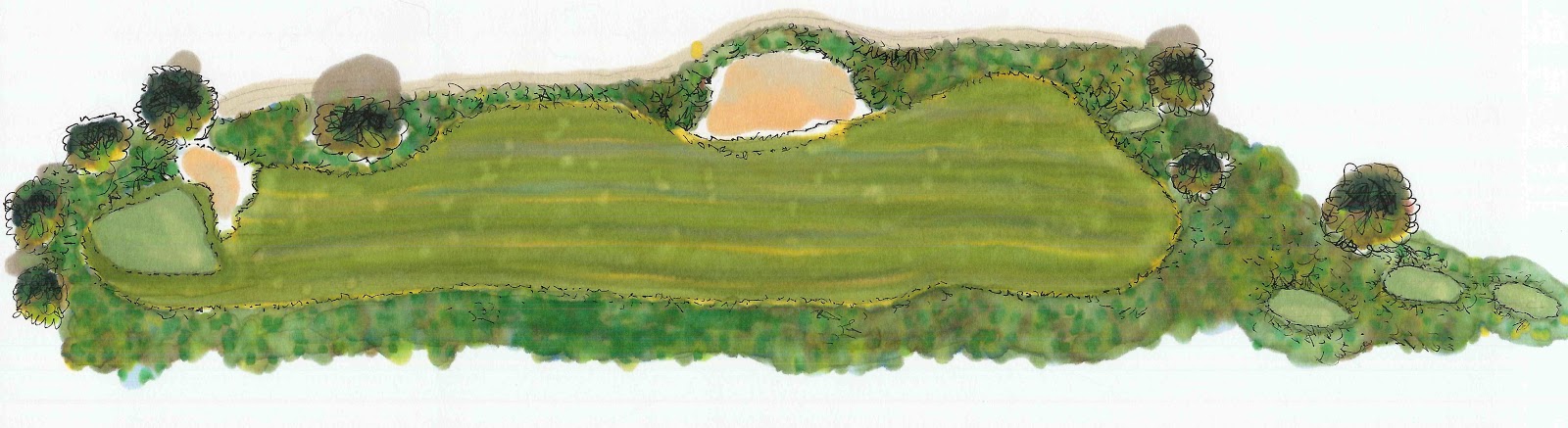
Sketch of the 16th at Sagebrush


This is a sketch of the half acre green at Sagebrush. There are 5 greens at Sagebrush that are between 13,000 and 22,000 square feet in size. The 18 greens have a total of 198,500 square feet and may be the largest set of creeping bentgrass greens in North America. The  intended firm and fast playability of the golf course and the scale of the property was such that the land screamed for large greens in most areas.
The greens were constructed in an unorthodox method, what may be termed as high tech push up greens or high performance modified greens. Compost and other nutrients were tilled into the soils prior to the finish grade. The greens were all built to accommodate our daily green speeds of 11-11.5  feet and have all pin positions available. The large greens each have two sprinklers in the middles of the greens.